Some time ago I came across one of leetcode issues [1] - to create pointers to next right nodes, given a balanced binary tree.
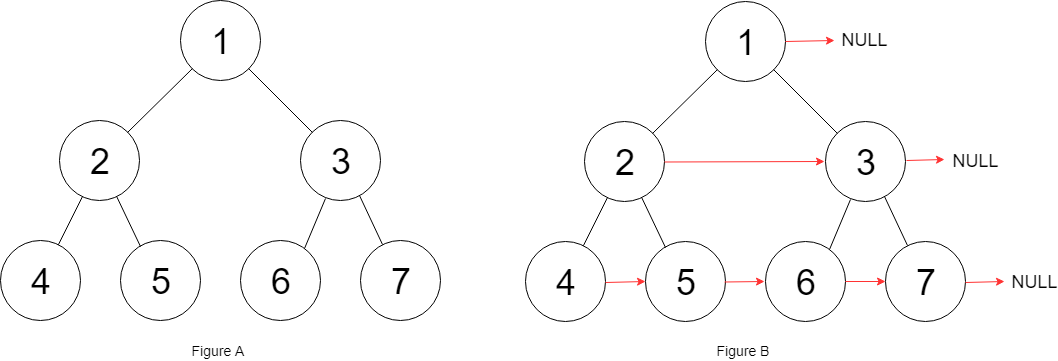
I decided to find out how this is done in real database systems and took PostgreSQL as an example. Postgres B-Tree indexes are multi-level tree structures, where each level of the tree can be used as a doubly-linked list of pages [2]:
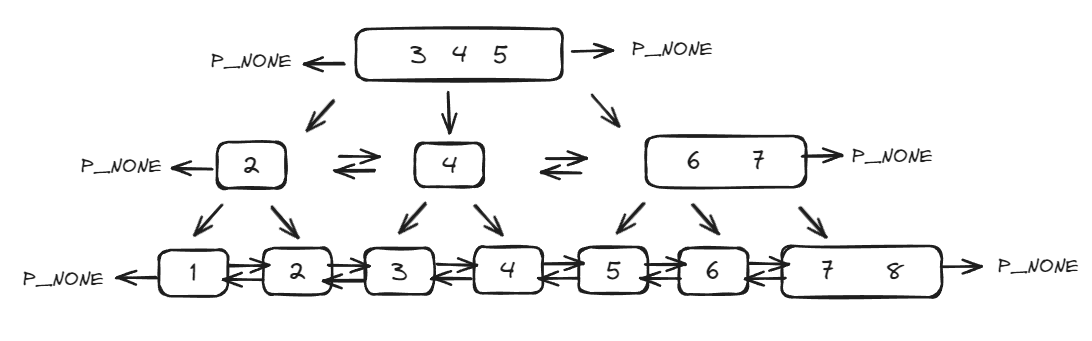
There are differences in Postgres comparing to leetcode assignment:
-
two pointers to right and left sibling pages
-
the pointers of the whole tree don’t get updated at once, only a tree’s fragment gets updated after splitting a tree
A structure BTPageOpaqueData holds pointers to both right and left siblings [3].
What does this structure allow a db engine do? When performing index scans, it’s easy and convenient to navigate to left and right pages, without having to start from a root node again and again.
In Postgres' source code, the method responsible for splitting a B-Tree is typically found within the file [4]. This file contains functions related to the insertion of new entries into B-Tree indexes.
The specific function responsible for splitting a B-Tree during insertion is called btsplit [5]. This function is called when a new entry cannot be accommodated within an existing page of the B-Tree due to space constraints. The btsplit function is responsible for splitting the page into two pages and redistributing the entries between them while maintaining the B-Tree’s properties.
As part of the split operation, pointers between the pages are updated.
References
-
[1] https://leetcode.com/problems/populating-next-right-pointers-in-each-node/description/
-
[2] https://www.postgresql.org/docs/16/btree-implementation.html
-
[3] https://github.com/postgres/postgres/blob/master/src/include/access/nbtree.h#L62
-
[4] https://github.com/postgres/postgres/blob/master/src/backend/access/nbtree/nbtinsert.c
-
[5] https://github.com/postgres/postgres/blob/master/src/backend/access/nbtree/nbtinsert.c#L1468
-
[6] https://leetcode.com/problems/balance-a-binary-search-tree/description/
Copyright © 2024 Petr Shatunov. All rights reserved.